About 57 minutes
Message From Mars — Reading Companion
Other Worlds
12,919 recorded words. 1 minutes difference from this book's estimate.
View Gutenberg source #62357
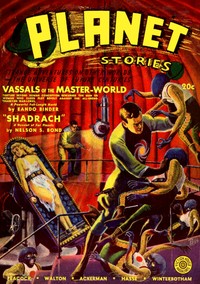
The catalog record for "Shadrach" — Inside the Classic provides practical reading context through 12,811 words, 56 min estimated reading time, and 2 detected text sections.
The text analysis averages about 14.1 words per sentence, while the detected sections provide another way to judge how the source is divided.
Project Gutenberg metadata also associates the work with “Science fiction,” connecting these edition facts with the source record’s subject description.
Explore this collection
These alternatives are selected using recorded categories and estimated reading time.
About 57 minutes
Other Worlds
12,919 recorded words. 1 minutes difference from this book's estimate.
View Gutenberg source #62357About 49 minutes
Other Worlds
11,223 recorded words. 7 minutes difference from this book's estimate.
View Gutenberg source #62035About 66 minutes
Other Worlds
15,125 recorded words. 10 minutes difference from this book's estimate.
View Gutenberg source #62382Search stored excerpts and compare books → Choose by your preferences →
Choices use stored catalog measurements. Estimates vary with reading speed. A shared category is a catalog label, not a claim that two books have the same argument or literary quality.
Search reads excerpt text stored with this catalog and links to its associated Gutenberg record. The connection is stored in the site database; this tool does not recheck that every excerpt is word-for-word identical to that external record. Excerpt search does not cover every chapter and does not verify historical publication dates.
Catalog snapshot checked: 2026-09-26. Coverage: 90 public books, 90 available source excerpts.
Calculated from edition completeness, EPUB availability, text structure and catalogue metadata. Not a user rating.
Total of 100 points, scaled to a 2.5-5.0 range. Editions with an empty description or a missing EPUB file are not scored.
Public-domain source text
The source text is kept in the dedicated reader, separate from this catalogue record and its commentary.
The story opens not on a distant moon but in Xuerl's Cosmobar, a dive on Mars where a very drunk man draws the attention of Chip Warren. The bar's atmosphere—described as a place where a spaceman can get "a weapon or a wench, a bottle or a battle"—establishes a rough, cynical tone. The patrons include a Venusian, a greenie, a runt, and an Earthman, a mix Chip mentally dismisses as "bugs in a rug." This setting, with its casual violence and alien bartender who "piped" English, contrasts sharply with the later, harsher environment of Titania.
The opening scene in Xuerl's Cosmobar does more than set mood; it introduces a key plot device. A newcomer slips his arm around the drunken man, and from the first Earthman's hand drops "a silvery, glistening, round something" that hits the floor and bounces. The reaction is immediate: four figures form a wall of flesh around the drunk. The object's nature is not explained, but its importance is clear. This moment of concealed action amid the bar's din—"in the din and confusion of Xuerl's Cosmobar it went unnoticed"—creates a tension that propels the narrative forward. The reader is left to wonder what the object is and why it matters.
After crash-landing on Titania, the characters face an environment where survival requires understanding alien physiology. When Chip Warren activates his suit's heater, a native howls and leaps away, treating the warmth as "a burning, unendurable heat." The missionary Salvation Smith explains that Titanians have "sluggish basal metabolism" and "dermal, rather than pneumonic respiration," enabling them to endure temperatures of minus 380° Fahrenheit. Chip must "freeze, and like it" to avoid offending his captors. This detail—that what feels cold to a human is normal to a Titanian—underscores the story's focus on physical and cultural difference.
The dark spot Chip observed from above turns out to be a patch where the icy blanket has been stripped away, revealing "raw and rocky core." Here, black rocks thrust upward, and gnarled trees and lichens eke out an existence. The natives have built a village: slab dwellings daubed with black clay, a central structure, and a market or gathering spot. This setting is described as "coarser, cruder, than the village of the meanest of Earth's savages." The contrast between the advanced technology of space travel and this primitive settlement highlights the alienness of Titania. The missionary's exclamation—"Behold! Thou hast delivered mine enemy into mine hands"—suggests a religious dimension to the encounter.
Bond's novella rewards attention to its contrasts: the seedy bar versus the frozen moon, the human need for heat versus the Titanian's intolerance of it, and the crude village versus the implied sophistication of spacefaring humans. The story's brevity—under 13,000 words—means each detail carries weight. Readers may find themselves questioning which side is truly savage, and whether the title's biblical allusion hints at a test of faith or a trial by fire in a world of ice.
I finished Shadrach this afternoon, closed the notebook, and thought about how those men held onto their rituals against that endless freeze. It left me with a particular quiet, the kind that lingers. Then I recalled Thralls of the Endless Night — Inside the Classic, and how some stories keep that same cold ache inside them, waiting for a warmer day to be remembered.
Your answers remain private and are stored only in this browser.