About 45 minutes
The Starbusters — Themes and Context
Space Future
10,152 recorded words. 1 minutes difference from this book's estimate.
View Gutenberg source #63855
Before opening Survival — A Closer Reading, the edition data offers a quick orientation: 10,504 words, 46 min estimated reading time, and 2 detected text sections.
The text analysis averages about 15.4 words per sentence, while the detected sections provide another way to judge how the source is divided.
Project Gutenberg metadata also associates the work with “Science fiction,” connecting these edition facts with the source record’s subject description.
Explore this collection
These alternatives are selected using recorded categories and estimated reading time.
About 45 minutes
Space Future
10,152 recorded words. 1 minutes difference from this book's estimate.
View Gutenberg source #63855About 44 minutes
Space Future
10,019 recorded words. 2 minutes difference from this book's estimate.
View Gutenberg source #63123About 49 minutes
Space Future
11,173 recorded words. 3 minutes difference from this book's estimate.
View Gutenberg source #62042Search stored excerpts and compare books → Choose by your preferences →
Choices use stored catalog measurements. Estimates vary with reading speed. A shared category is a catalog label, not a claim that two books have the same argument or literary quality.
Search reads excerpt text stored with this catalog and links to its associated Gutenberg record. The connection is stored in the site database; this tool does not recheck that every excerpt is word-for-word identical to that external record. Excerpt search does not cover every chapter and does not verify historical publication dates.
Catalog snapshot checked: 2026-09-26. Coverage: 90 public books, 90 available source excerpts.
Calculated from edition completeness, EPUB availability, text structure and catalogue metadata. Not a user rating.
Total of 100 points, scaled to a 2.5-5.0 range. Editions with an empty description or a missing EPUB file are not scored.
Public-domain source text
The source text is kept in the dedicated reader, separate from this catalogue record and its commentary.
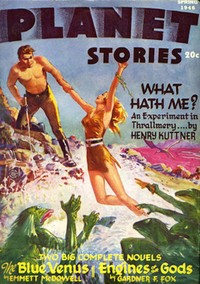
Basil Wells's Survival opens with a failed experiment that swaps human egos into the bodies of Venusian frog-like beings. The blast from a shorted machine kills the scientists and flings the minds of people in Crayton, Ohio, across space. The story is framed as a retrospective account learned from Venusians who later visited Earth aboard the Malcolm. This setup immediately establishes a tension between human identity and alien physiology.
The protagonist, Glade Masson, awakens in a hollow of dank grayish ooze. He examines his new form: webbed hands with six fingers, a sleek gray body, and a noseless face with round dark eyes. His first reaction is to gasp, 'A frog!' The narrative dwells on physical details—the crossed belts of ridged hide, the bone dagger, the belch revealing a diet of overripe fish. This disorientation is not merely cosmetic; it forces a re-evaluation of what it means to be human. Masson flexes his thick arms, admiring the ripple of hard muscle, yet his body is alien. The text repeatedly contrasts his former timid, myopic professor self with this new powerful but grotesque vessel.
Masson and other Earthmen adapt by raiding the villages of the Butrads, the native frog-like beings. They steal females to ensure the colony's future. The logic is stark: 'To survive, we must fight with all means at our command. We must steal, we must kill, and we must work.' The Earthmen's round dark eyes brighten with hope as they embrace this brutal pragmatism. Yet the colony faces a crisis: the eggs of the captured females fail to hatch. The old women of the tribes carry eggs away and return with young, but the process is taboo. Masson decides to follow them, accompanied by the scarred Joe Dolan, who can whistle despite his frog mouth—a small, absurd detail that underscores their strange new existence.
The Venusian environment is a constant presence: soupy fog, dank ooze, twisting vines, and a ravine that becomes a vertical-walled tunnel of thidin vines and scaly gray rock. The Earthmen climb into stunted cliffs and peaks, sleeping above the Butrad ancients. The final revealed landscape is a roughly oval bowl of writhing mist, with miniature buttes, mesas, and cliffs splitting the terrain into 'a hell of broken terrain.' This setting is not a backdrop but an active obstacle, forcing the characters to navigate both physical and psychological boundaries. The fog limits visibility to the length of two bodies, heightening the sense of isolation and threat.
Wells's story is notable for its unflinching treatment of identity displacement and moral compromise. The Earthmen's struggle is not just against the environment but against the loss of their own humanity. Readers should attend to how the narrative balances the grotesque with the familiar, and how the characters' decisions reflect a tension between survival and ethics. The incomplete excerpts leave the resolution of the sterility crisis unknown, inviting speculation about what Masson and Dolan will find in the hidden bowl.
Reading about Glade Masson’s body not feeling like his own reminded me of a night I spent with Terror Out of Space — Story, Setting & Ideas, where the same ache of displacement crept through. Both stories left me staring at my hands afterward, grateful they were mine, and quietly aware how thin that boundary really is.
Create a short personal record of your experience with this book.