About 20 minutes
Black-out — A Closer Reading
Space Future
4,557 recorded words. 1 minutes difference from this book's estimate.
View Gutenberg source #62426
The catalog record for The Ballad of Blaster Bill — Story, Setting & Ideas provides practical reading context through 4,789 words, 21 min estimated reading time, and 1 detected text section.
The text analysis averages about 20.2 words per sentence, while the detected sections provide another way to judge how the source is divided.
Project Gutenberg metadata also associates the work with “Humorous poetry,” connecting these edition facts with the source record’s subject description.
Explore this collection
These alternatives are selected using recorded categories and estimated reading time.
About 20 minutes
Space Future
4,557 recorded words. 1 minutes difference from this book's estimate.
View Gutenberg source #62426About 22 minutes
Space Future
4,953 recorded words. 1 minutes difference from this book's estimate.
View Gutenberg source #63782About 18 minutes
Space Future
4,041 recorded words. 3 minutes difference from this book's estimate.
View Gutenberg source #63758Search stored excerpts and compare books → Choose by your preferences →
Choices use stored catalog measurements. Estimates vary with reading speed. A shared category is a catalog label, not a claim that two books have the same argument or literary quality.
Search reads excerpt text stored with this catalog and links to its associated Gutenberg record. The connection is stored in the site database; this tool does not recheck that every excerpt is word-for-word identical to that external record. Excerpt search does not cover every chapter and does not verify historical publication dates.
Catalog snapshot checked: 2026-09-26. Coverage: 90 public books, 90 available source excerpts.
Calculated from edition completeness, EPUB availability, text structure and catalogue metadata. Not a user rating.
Total of 100 points, scaled to a 2.5-5.0 range. Editions with an empty description or a missing EPUB file are not scored.
Public-domain source text
The source text is kept in the dedicated reader, separate from this catalogue record and its commentary.
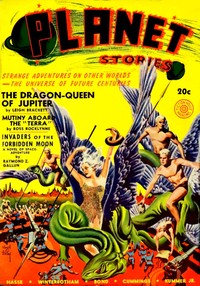
Nelson S. Bond's The Ballad of Blaster Bill is a narrative poem that blends science fiction with broad comedy, first published in Planet Stories (Summer 1941). The poem opens with a striking image: space travelers saluting a lonely beacon—the final resting place of Blaster Bill. This ritual frames the story as a legend told among spacemen, setting a tone of irreverent myth-making. The verse form, with its regular rhyme and meter, recalls traditional ballads but is filled with space-age slang and technical jargon, creating a playful contrast between the old-fashioned storytelling mode and the futuristic setting.
The central tension in the excerpt is between two sharply drawn characters: Jonathan McNeer, the Master Engineer, and Bill the Blaster. McNeer is described as "gruff, uncouth, unclean" with a temper like fire, yet he is a skilled professional who demands perfection. Bill, by contrast, is presented as lazy and accident-prone—"without ever even trying / He could make McNeer start crying." Their conflict is established through exaggerated language and physical comedy: Bill's clumsiness is described as "vivisection" on machinery, and McNeer's complaints are peppered with colorful threats. The Skipper's mild attempts to mediate only deepen the friction. This dynamic drives the poem's humor and sets up the inevitable disaster.
Bond's poem is notable for its inventive use of space-age terminology within a strict ballad structure. Terms like "perihelion run," "hypatomic motors," and "rocket-blasts" are woven into rhyming couplets and quatrains, often with playful results. For example, the line "Just one look at him and tubes sang, 'Ohm, sweet Ohm!'" puns on the electrical unit and the exclamation "Oh my." The poem also employs space slang such as "rankey-pot" (a nosy person) and "globaar" (an insult), grounding the fantastical setting in a lived-in vernacular. This blend of technical and colloquial language gives the poem a distinctive voice that is both futuristic and earthy.
The setting of the poem is confined largely to the spaceship Dotty Sue, described as a "wallowing old freighter." This vessel is not a sleek starship but a working-class craft, and its humble nature contrasts with the grand backdrop of space. The poem's action takes place during routine maintenance—cleaning the "hypatomic motors" while the ship free-wheels through the void. This mundane task becomes the stage for high-stakes comedy. The ship's name, Dotty Sue, suggests a folksy, unpretentious character, reinforcing the poem's tone. The setting is further defined by the crew's hierarchy, from the "lowest wiper" to the Skipper, all of whom participate in the salute to Bill's grave.
Readers should approach The Ballad of Blaster Bill as a light-hearted entertainment that rewards attention to its wordplay and rhythmic ingenuity. The poem's humor depends on the contrast between the serious conventions of space opera and the absurdity of Bill's incompetence. While the excerpts provide only the opening sections, the poem's structure as a ballad suggests a complete narrative arc, likely culminating in the accident that leads to Bill's lonely memorial. The work is best enjoyed aloud, where its rhymes and rhythms can be fully appreciated.
Reading about Blaster Bill fumbling through his asteroid runs took me back to evenings on my grandfather's porch, the hum of crickets filling pauses between stories. His voice had that same clumsy warmth. That feeling returned when I opened Mutiny — Reading Notes, where quiet rebellion feels less like chaos and more like a held breath. Both books remind me how tenderness hides inside gruffness, how we saluting the stars we never quite reach.
Create a short personal record of your experience with this book.









