
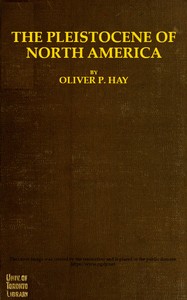
The Pleistocene of North America by Oliver Perry Hay
Let's be clear from the start: this isn't a novel. Oliver Perry Hay's 'The Pleistocene of North America' is a foundational scientific work, published in 1923. There's no plot in the traditional sense. Instead, the 'story' is the investigation itself. Hay, a respected paleontologist, takes on the role of a compiler and a detective. His mission? To gather everything known at the time about the massive creatures that called North America home during the Ice Age.
The Story
Hay systematically catalogs the fossil record. He goes animal by animal—the mammoth, the mastodon, the dire wolf, the giant beaver. For each one, he describes where their bones have been found, what scientists think they looked like, and how they might have behaved. He pieces together their world from fragments of teeth and tusks. The narrative tension comes from the gaps in knowledge. Hay is working with a puzzle where half the pieces are missing, and he's carefully explaining what the existing pieces suggest about the bigger picture. The 'ending' isn't a conclusion we know today, but a snapshot of what the scientific frontier looked like a hundred years ago.
Why You Should Read It
Reading this today is a unique experience. You're not just learning about Ice Age animals; you're learning about how we learned about them. You see the early, sometimes clunky, steps of a science finding its feet. Hay's writing, while technical, has a palpable sense of wonder. You can feel his excitement when he discusses a new fossil find or a puzzling set of tracks. It’s a reminder that these fantastical creatures were once real, and their discovery was as thrilling as any fiction. It connects you directly to the moment when these giants stepped out of myth and into science.
Final Verdict
This book is perfect for history and science lovers with a sense of curiosity. It's not a light read, but it's a rewarding one. Think of it as a primary source—a direct line to the early 20th-century mind. If you enjoy museums, natural history, or the idea of seeing how scientific ideas are built brick by brick, you'll find this fascinating. It's not for someone looking for a dramatic story, but for the reader who wants to stand beside the original explorers of deep time and look at the bones of a lost world.
This work has been identified as being free of known copyright restrictions. Use this text in your own projects freely.
Kimberly Thompson
2 years agoAfter spending a few days with this digital edition, the cross-referencing of different chapters makes it a great study tool. I'll be citing this in my upcoming project.
William White
1 week agoComparing this to other titles in the same genre, the argument presented in the middle section is particularly compelling. The price-to-value ratio here is simply unbeatable.
Margaret White
6 months agoIf you're tired of surface-level information, the logic behind each conclusion is easy to follow and verify. Definitely a five-star contribution to the field.
George Lee
6 months agoThe author provides a very nuanced critique of current methodologies.




Barbara Harris
1 month agoI wanted to compare this perspective with traditional views, the step-by-step breakdown of the methodology is extremely helpful for students. The price-to-value ratio here is simply unbeatable.