About 98 minutes
Prey of the Space Falcon — Story, Setting & Ideas
Space Future
22,446 recorded words. 9 minutes difference from this book's estimate.
View Gutenberg source #62546
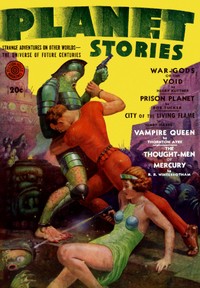
For City of the Living Flame — A Closer Reading, the stored edition analysis reports 20,372 words, 1 hr 29 min estimated reading time, and 2 detected text sections.
The text analysis averages about 13.5 words per sentence, while the detected sections provide another way to judge how the source is divided.
Project Gutenberg metadata also associates the work with “Science fiction,” connecting these edition facts with the source record’s subject description.
Explore this collection
These alternatives are selected using recorded categories and estimated reading time.
About 98 minutes
Space Future
22,446 recorded words. 9 minutes difference from this book's estimate.
View Gutenberg source #62546About 80 minutes
Space Future
18,250 recorded words. 9 minutes difference from this book's estimate.
View Gutenberg source #63872About 77 minutes
Space Future
17,572 recorded words. 12 minutes difference from this book's estimate.
View Gutenberg source #62498Search stored excerpts and compare books → Choose by your preferences →
Choices use stored catalog measurements. Estimates vary with reading speed. A shared category is a catalog label, not a claim that two books have the same argument or literary quality.
Search reads excerpt text stored with this catalog and links to its associated Gutenberg record. The connection is stored in the site database; this tool does not recheck that every excerpt is word-for-word identical to that external record. Excerpt search does not cover every chapter and does not verify historical publication dates.
Catalog snapshot checked: 2026-09-26. Coverage: 90 public books, 90 available source excerpts.
Calculated from edition completeness, EPUB availability, text structure and catalogue metadata. Not a user rating.
Total of 100 points, scaled to a 2.5-5.0 range. Editions with an empty description or a missing EPUB file are not scored.
Public-domain source text
The source text is kept in the dedicated reader, separate from this catalogue record and its commentary.
Henry Hasse's City of the Living Flame (1942) opens with Jim Landor piloting a rocket-plane over Mars's polar cap, searching for the mythical city M'Tonak. The narrative immediately establishes a tension between practical motives—avoiding magnetic storms—and a private, almost irrational compulsion: Landor believes the city holds his missing brother. Hasse's prose relies on sensory details: the "ghostly whirr" of wings, "powdery sand" rising "cloud-fine," and a "glaucous radiance" that later becomes a pulsing green light. The author builds unease through Landor's internal conflict, as he acknowledges a "growing, nameless dread" that makes him reserved. This opening sets up a quest driven by personal desperation rather than heroic ambition.
Hasse's word choices consistently evoke involuntary action and psychological pressure. Landor is "persuaded against all reason" to search, and later he feels "led somewhere" by an unseen force. Verbs like "pluck with evil intentness" and "probed into his brain" attribute agency to the environment. The flame's light is described as "almost tangible," "beating against him," and causing a "cold fear" that "caught his brain." This diction blurs the line between external threat and internal breakdown, emphasizing the character's loss of control.
The narrative adheres closely to Landor's point of view, filtering events through his senses and thoughts. Hasse uses phrases like "he seemed to know it" and "he could not be sure" to maintain uncertainty. The reader experiences the corridor's "greenish-gloomy" marble and the "blinding" light only as Landor does. When he laughs "wildly" without pause, the voice conveys a fractured rationality. This limited perspective prevents objective confirmation of the flame's nature, keeping the threat ambiguous and psychological.
The journey into M'Tonak follows a deliberate structural pattern: a corridor that turns "sharply once, and then again," leading downward. Hasse repeats phrases like "he continued" and "he could only go on" to create a sense of inexorable progress. The light intensifies in stages—from a "glaucous radiance" to a "steady pulsation"—building toward the revelation of the "huge circular glass-enclosed well." The climax is a moment of horror: Landor glimpses a "roughly globular, quasi-amorphous shape" in constant flux. The structure mirrors a descent into the subconscious, with the flame as a psychic entity.
Two motifs dominate the excerpts: light and tactile sensation. The green light is described as "ineffably green as the light beneath the waters of a shallow sea," then as "streamers of a darker color flashing through it vertically." It "flared up once in a great greenish effulgence" before settling into a pulse. Simultaneously, Landor feels "a million tiny fingers tearing away the shreds of his mind" and "a million eyes watching." These synesthetic descriptions—light that touches, eyes that probe—reinforce the flame's sentience and malevolence, making the environment an active antagonist.
Readers should attend to how Hasse uses the first-person-limited viewpoint to restrict knowledge: the flame's true nature remains glimpsed rather than explained. The novella's power lies in its sustained atmosphere of compulsion and dread, achieved through precise diction and a structure that mirrors psychological descent. The excerpts suggest a story more concerned with internal experience than with action or resolution.
In City of the Living Flame, I always pause on that aching privacy—how the flame's pressure isolates Jim until even the Martian light feels like touch. That same loneliness, softened but unresolved, lingers in In the Garden — Themes and Context, where the green hush holds its own quiet communion. Some gardens keep their whispers; some flames do. Both simply wait.
Build a private reading journal entry for this title.









