About 65 minutes
Lord of a Thousand Suns — Background and Themes
Social Speculation
14,765 recorded words. 7 minutes difference from this book's estimate.
View Gutenberg source #63993
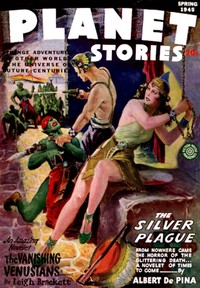
Before opening The Silver Plague — Key Ideas to Explore, the edition data offers a quick orientation: 16,387 words, 1 hr 12 min estimated reading time, and 2 detected text sections.
The text analysis averages about 17.7 words per sentence, while the detected sections provide another way to judge how the source is divided.
Project Gutenberg metadata also associates the work with “Science fiction,” connecting these edition facts with the source record’s subject description.
Explore this collection
These alternatives are selected using recorded categories and estimated reading time.
About 65 minutes
Social Speculation
14,765 recorded words. 7 minutes difference from this book's estimate.
View Gutenberg source #63993About 54 minutes
Social Speculation
12,320 recorded words. 18 minutes difference from this book's estimate.
View Gutenberg source #63645About 90 minutes
Social Speculation
20,484 recorded words. 18 minutes difference from this book's estimate.
View Gutenberg source #63885Search stored excerpts and compare books → Choose by your preferences →
Choices use stored catalog measurements. Estimates vary with reading speed. A shared category is a catalog label, not a claim that two books have the same argument or literary quality.
Search reads excerpt text stored with this catalog and links to its associated Gutenberg record. The connection is stored in the site database; this tool does not recheck that every excerpt is word-for-word identical to that external record. Excerpt search does not cover every chapter and does not verify historical publication dates.
Catalog snapshot checked: 2026-09-26. Coverage: 90 public books, 90 available source excerpts.
Calculated from edition completeness, EPUB availability, text structure and catalogue metadata. Not a user rating.
Total of 100 points, scaled to a 2.5-5.0 range. Editions with an empty description or a missing EPUB file are not scored.
Public-domain source text
The source text is kept in the dedicated reader, separate from this catalogue record and its commentary.
The story opens not with action but with Fermin, the Arch-Mutant, reading Seville-Lorca's history of the Jovian Moons in his austere cloister on Ganymede. The excerpt presents a layered society: Mutants, described as silver-haired and silver-eyed, were exiled from Terra after the 'Great Unrest' due to their 'infinite capacity for intrigue.' The narrative voice is detached, almost scholarly, as it recounts the colonization of Ganymede—a world that already had its own civilization. This historical framing immediately establishes a tension between the Mutants' forced migration and Terra's desire to forget its wartime origins.
Julian's escape from the temple after killing Fermin reveals a Ganymede built on secrecy. The guards are careless with routine, but the city itself is a labyrinth of hidden signs. Julian must find the Paradisiac, a pleasure den whose location is known only to initiates. He uses a secret Dekka wavelength, a wrist-transmitter, and a rapier-scabbard to tap a coded series of sounds on a beryloid wall. The wall parts just wide enough for him to squeeze through. The environment is hostile: a 'pink fog' obscures vision, power-beams splash off walls, and oaths in various dialects fill the air. Sanctuary exists 'for the asking—at a price,' but the signs are subtle. This emphasis on coded communication and concealed spaces suggests a society where trust is scarce and survival depends on knowing the right signals.
The historical excerpt within the story provides a damning account of Terra's treatment of Mutants. Mutants are described as 'a constant reminder of a recent barbarism,' and their exile to the Jovian Moons is framed as a 'magnanimous gesture' that ignored Ganymede's existing civilization. The text notes that Mutants were the 'direct result of malignant rays and fiendish gases' from ancient wars—a biological scar of human conflict. This backstory colors the present action: Fermin, the Arch-Mutant, is a figure of power and irony, planning to add an 'anti-climax' to the historians' work. Julian, though not a Mutant, operates in a world shaped by this history. The tension between Terra's aloofness and the Mutants' resentment is a quiet undercurrent, hinted at in Fermin's reading and the Dekka's covert operations.
Two objects drive the plot in the excerpts: a tiny vial of colorless liquid, fashioned from a single blood-red Panagran, and the word 'Paradisiac' frozen in a neutralized telesolidograph screen. Julian takes the vial from Fermin's body, but its purpose is unexplained. The frozen word is more puzzling—it was the name of the rendezvous point, yet Fermin had somehow obtained that information, suggesting a leak in the Dekka. Julian's confusion is explicit: 'How Fermin... had managed to obtain that information was incredible!' These details create a sense of hidden layers. The vial may be a weapon, a cure, or a key; the frozen word implies surveillance or betrayal. The story withholds their meanings, leaving the reader to wonder how these objects will intersect with the silver plague and the broader conflict.
The excerpts present a world where history is weaponized, spaces are coded, and objects carry unknown significance. Readers should pay attention to how the silver plague is described when it appears—whether as a literal disease or a metaphor for the Mutants' condition. The tension between Fermin's scholarly detachment and Julian's desperate flight sets up a contrast between contemplation and action. The story's brevity (under 17,000 words) suggests a tight plot where every detail may matter.
That rainy afternoon, I kept returning to the silver plague’s slow creep through the cloister, and Julian’s desperate flight felt oddly like my own restless thumbing of pages. Later, I found myself thinking about monstrosity—not mutant, but quieter—and picked up The Last Monster — Key Ideas to Explore almost without deciding to. The rain never stopped. Both books shared that same grey hush.
Use these questions to collect your thoughts before moving on.