About 110 minutes
The Lost Tribes of Venus — Background and Themes
Space Future
25,261 recorded words. 0 minutes difference from this book's estimate.
View Gutenberg source #63932
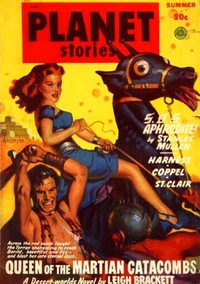
Before opening Queen of the Martian Catacombs — Key Ideas to Explore, the edition data offers a quick orientation: 25,163 words, 1 hr 50 min estimated reading time, and 3 detected text sections.
The text analysis averages about 13.2 words per sentence, while the detected sections provide another way to judge how the source is divided.
Project Gutenberg metadata also associates the work with “Science fiction,” connecting these edition facts with the source record’s subject description.
Explore this collection
These alternatives are selected using recorded categories and estimated reading time.
About 110 minutes
Space Future
25,261 recorded words. 0 minutes difference from this book's estimate.
View Gutenberg source #63932About 113 minutes
Space Future
25,844 recorded words. 3 minutes difference from this book's estimate.
View Gutenberg source #61316About 98 minutes
Space Future
22,446 recorded words. 12 minutes difference from this book's estimate.
View Gutenberg source #62546Search stored excerpts and compare books → Choose by your preferences →
Choices use stored catalog measurements. Estimates vary with reading speed. A shared category is a catalog label, not a claim that two books have the same argument or literary quality.
Search reads excerpt text stored with this catalog and links to its associated Gutenberg record. The connection is stored in the site database; this tool does not recheck that every excerpt is word-for-word identical to that external record. Excerpt search does not cover every chapter and does not verify historical publication dates.
Catalog snapshot checked: 2026-09-26. Coverage: 90 public books, 90 available source excerpts.
Calculated from edition completeness, EPUB availability, text structure and catalogue metadata. Not a user rating.
Total of 100 points, scaled to a 2.5-5.0 range. Editions with an empty description or a missing EPUB file are not scored.
Public-domain source text
The source text is kept in the dedicated reader, separate from this catalogue record and its commentary.
The story opens with a rider fleeing across the Martian desert on a spent beast. The prose is immediate and physical: the creature's eyes burn like green lamps, the wind is bitter cold, and the man wears only a ragged shirt of Venusian spider silk. Brackett establishes Stark's otherness through his stillness—a patience as unhuman as the rock—and his dark skin burned by an unnamed sun. The first excerpt ends as his pursuers assemble a Banning shocker, a weapon name that hints at the story's pulp-tech texture. This opening rewards readers who notice how setting and action are fused: the desert is not backdrop but antagonist, and Stark's movements are described with the precision of a survival manual.
The opening chase is a masterclass in economical tension. Brackett uses short, declarative sentences: “He dismounted.” “He looked back.” “He stood still.” The four black shadows in the distance are never named; they are simply threats. Stark’s decision to run toward the tor is presented as a tactical calculation, not heroics. His gun is drawn, but he does not fire. The excerpt ends before the shocker is used, leaving the reader in suspense. Notice how Brackett withholds interior monologue—Stark’s thoughts are limited to immediate problems: the beast is spent, the ridge is too far, the rocks offer cover. This restraint builds a character who is defined by action and observation, not introspection.
In the later excerpt, a dust storm becomes a weapon. Brackett personifies the wind as a “giantess in travail” that “shook” the sky and “tore it open.” The sensory assault is relentless: blind dust, screaming wind, trampling hoofs. Stark is dragged from his saddle by Luhar and Freka, who intend the storm to kill him. The scene is notable for its physical chaos—Stark grapples with Berild in the murk, mistakes her for Fianna, and clings to a pack beast’s lashings. Brackett’s prose shifts from the clean lines of the opening to a tangle of bodies and fabric. The scarf tied over the beast’s head to help it breathe is a small, vivid detail that grounds the fantastic in practical survival.
Though the excerpts contain little dialogue, Brackett’s voice emerges through exclamations and curses. Stark’s muttered “by the Nine Hells” and the clipped commands of the pursuers (“The leader motioned. The others dismounted.”) create a world of hard men and harsh codes. The names—Valkis, Luhar, Freka, Berild, Fianna—carry a phonetic weight that suggests a fallen civilization. Brackett does not explain Martian society; she lets the reader infer from the presence of a “Banning shocker” and the mention of Venusian silk that this is a galaxy with trade and technology. The dialogue is sparse, but when Berild gasps “It was I, and not Fianna,” the line carries both relief and danger, hinting at a love triangle or mistaken identity that the excerpts do not resolve.
The three excerpts trace a clear arc: flight, ambush, and survival. But the story is incomplete—the catacombs of the title are never reached in these passages. Brackett uses the desert as a crucible, stripping Stark of his mount, his companions, and his bearings. The storm scatters the caravan “like a drift of autumn leaves,” and Stark is left afoot with Berild. The final image of the excerpt—Stark struggling forward, remembering Kynon’s words—suggests a larger plan or prophecy. Readers should note that Brackett’s structure relies on physical obstacles rather than psychological depth. The tension comes from whether Stark will reach Valkis, not from why he is fleeing. This forward momentum is the engine of the narrative.
Brackett’s prose rewards attention to the physical world: the texture of sand, the weight of a weapon, the sound of a wind. The excerpts offer no easy answers about the catacombs or the queen, but they establish a protagonist who endures through cunning and resilience. Read for the sensory detail and the lean, unadorned action. The story’s pleasures lie in its surfaces—the grit of the desert, the hiss of a beast, the flash of a silken scarf in a storm.
Stark’s lean journey through the catacombs always reminds me of how much a story can hold back and still say. There’s a similar hush in Survival — A Closer Reading, where every pause feels measured, like old friends sharing a quiet glance. Brackett’s dust and stillness find a gentle echo there.
Capture what you thought, learned, and would like to remember.









