About 33 minutes
The Rhizoid Kill — Reading Notes
Machines Invention
7,479 recorded words. 3 minutes difference from this book's estimate.
View Gutenberg source #63891

If You're Smart— — Inside the Classic can be approached with a clearer sense of reading commitment from its source measurements: 8,151 words, 36 min estimated reading time, and 1 detected text section.
The text analysis averages about 15.6 words per sentence, while the detected sections provide another way to judge how the source is divided.
Project Gutenberg metadata also associates the work with “Science fiction,” connecting these edition facts with the source record’s subject description.
Explore this collection
These alternatives are selected using recorded categories and estimated reading time.
About 33 minutes
Machines Invention
7,479 recorded words. 3 minutes difference from this book's estimate.
View Gutenberg source #63891About 29 minutes
Machines Invention
6,609 recorded words. 7 minutes difference from this book's estimate.
View Gutenberg source #63708About 28 minutes
Machines Invention
6,234 recorded words. 8 minutes difference from this book's estimate.
View Gutenberg source #63676Search stored excerpts and compare books → Choose by your preferences →
Choices use stored catalog measurements. Estimates vary with reading speed. A shared category is a catalog label, not a claim that two books have the same argument or literary quality.
Search reads excerpt text stored with this catalog and links to its associated Gutenberg record. The connection is stored in the site database; this tool does not recheck that every excerpt is word-for-word identical to that external record. Excerpt search does not cover every chapter and does not verify historical publication dates.
Catalog snapshot checked: 2026-09-26. Coverage: 90 public books, 90 available source excerpts.
Calculated from edition completeness, EPUB availability, text structure and catalogue metadata. Not a user rating.
Total of 100 points, scaled to a 2.5-5.0 range. Editions with an empty description or a missing EPUB file are not scored.
Public-domain source text
The source text is kept in the dedicated reader, separate from this catalogue record and its commentary.
The story opens with a blunt challenge: "If you're so damn smart, why ain't you rich?" Financier Wolf Carmichael hurls this centuries-old taunt at inventor Dr. Claud Kellog. Carmichael, described with "roving, piggish eyes" and a "triple chin," embodies ruthless capitalism. Kellog's retort—citing Archimedes cornering the wine-press market—sets up a conflict not just of personalities but of worldviews: pure profit versus applied ingenuity. The excerpts reveal a pattern of asymmetrical power plays, where Carmichael uses legal and economic leverage while Kellog relies on his antichron device, a machine that warps space-time. This tension between financial and scientific power drives the narrative.
The antichron device is not merely a scientific marvel; it is a tool for economic warfare. Initially designed for "sight-sound" communication, Kellog and his assistant Billy Wade repurpose it to transmit electrical power from Earth to Titan, undercutting Carmichael's local monopoly. The text shows Kellog thinking in business terms: he calculates rates ("ten cents a mega-watt hour") and places ads in the Saturnport Herald. Wade's suggestion to "peddle some juice on the side" reveals a pragmatic streak. The device's flexibility—shifting from light to current, from communication to power—mirrors Kellog's adaptive strategy against Carmichael's fixed assets.
Carmichael does not rely solely on financial muscle; he manipulates legal and political systems. After Kellog undercuts Titan Power, Carmichael obtains an injunction against "unfranchised sale of power" and pressures the Saturnport Council to ban imported power. The text notes the "corrupt local court" and council members as "creatures of Carmichael." This escalates the conflict beyond a simple inventor-versus-capitalist story into a critique of captured institutions. Kellog's response—building "old-fashioned magnetic generators"—shows his resourcefulness, but the excerpts leave unclear whether legal obstacles ultimately constrain his technological advantage.
Dialogue reveals character and power dynamics. Carmichael's speech is larded with dismissive phrases: "Never heard of him," "Musta been some little fellow on Venus." His offer to Kellog—55% of stock for himself, 20% sold to the public, the rest to Kellog—is delivered with a "nasty chuckle." Kellog's responses are measured but cutting: "That's pure burglary." Wade's interjections ("Wolf is the word," "You can't beat him") provide a chorus of realism. The contrast between Carmichael's crude confidence and Kellog's controlled anger drives the narrative tension, with each line of dialogue advancing their strategic duel.
The excerpts present a contest where technological innovation repeatedly outmaneuvers financial and legal power, but the outcome remains uncertain. Readers should attend to how the story balances Kellog's victories with Carmichael's retaliations, and whether the antichron's capabilities ultimately transcend the systems that constrain it. The interplay of dialogue, device specifications, and business maneuvers rewards close attention to detail.
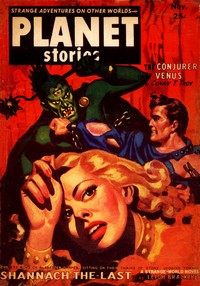
There’s a certain sly satisfaction in watching an inventor outfox a tycoon with nothing but time itself, as in If You're Smart. That quiet triumph reminds me of another lonely fight, a last stand against oblivion, found in Shannach—The Last — Reading Notes. Both whisper about wit being our truest armor when the world turns hostile.
A brief reflection can help important ideas stay with you longer.