About 63 minutes
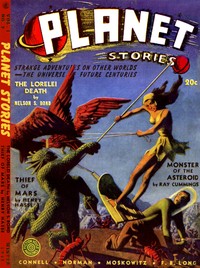
Monster of the Asteroid — Text and Context
Machines Invention
14,341 recorded words. 19 minutes difference from this book's estimate.
View Gutenberg source #62040

Before opening Vandals of the Void — Inside the Classic, the edition data offers a quick orientation: 18,767 words, 1 hr 22 min estimated reading time, and 3 detected text sections.
The text analysis averages about 14.9 words per sentence, while the detected sections provide another way to judge how the source is divided.
Project Gutenberg metadata also associates the work with “Science fiction,” connecting these edition facts with the source record’s subject description.
Explore this collection
These alternatives are selected using recorded categories and estimated reading time.
About 63 minutes
Machines Invention
14,341 recorded words. 19 minutes difference from this book's estimate.
View Gutenberg source #62040About 102 minutes
Machines Invention
23,308 recorded words. 20 minutes difference from this book's estimate.
View Gutenberg source #64026About 120 minutes
Machines Invention
27,549 recorded words. 38 minutes difference from this book's estimate.
View Gutenberg source #63942Search stored excerpts and compare books → Choose by your preferences →
Choices use stored catalog measurements. Estimates vary with reading speed. A shared category is a catalog label, not a claim that two books have the same argument or literary quality.
Search reads excerpt text stored with this catalog and links to its associated Gutenberg record. The connection is stored in the site database; this tool does not recheck that every excerpt is word-for-word identical to that external record. Excerpt search does not cover every chapter and does not verify historical publication dates.
Catalog snapshot checked: 2026-09-26. Coverage: 90 public books, 90 available source excerpts.
Calculated from edition completeness, EPUB availability, text structure and catalogue metadata. Not a user rating.
Total of 100 points, scaled to a 2.5-5.0 range. Editions with an empty description or a missing EPUB file are not scored.
Public-domain source text
The source text is kept in the dedicated reader, separate from this catalogue record and its commentary.
The opening of Vandals of the Void introduces Art Douglas, a scientist at the Interplanetary Research Institute, which is described as “utterly bogged down” and “close to absolute disintegration.” The story’s first tension emerges immediately: the Institute’s paralysis versus the urgent, alien challenge represented by a bizarre organism brought from deep underground. This creature—a spiral screw about a foot long, with three needle-sharp jaws and a steely hardness—bores only upward, a detail that becomes central to the plot. The narrative voice blends technical observation with a sense of impending doom, as Douglas “could plainly see its potentialities” but cannot yet dream of the full menace. The excerpt establishes a pattern of human institutions failing to cope with threats that originate from the void, setting up a contrast with the Martians, who appear later with a ready-made weapon.
The alien organisms, called Ghlak-Ileth by the Martians, are described with precise physical and behavioral details. They are “dull blue-black,” spiral, and “constantly whipping about,” trying to fasten their jaws into anything overhead. Their instinct to bore only upward is a key trait: when laid on a flat table, they merely writhe, searching for something above. This upward-boring behavior is later explained as part of a three-thousand-year cycle: the creatures are planted as spores, dig downward to feed on radium, then return to the surface to be harvested by the Voornizar. The text emphasizes their mechanical, almost designed nature—“It seemed to have been designed for just that”—and their resilience: “time means nothing to them—nor do heat, cold or lack of atmosphere affect them.” This biological weapon is not a random monster but a tool in an interstellar economy, which gives the story a speculative edge beyond simple invasion.
The narrative repeatedly contrasts human institutions with Martian competence. The Interplanetary Research Institute is “bogged down” and “close to absolute disintegration,” while the Martians, represented by Klalmar-lan, have already developed a countermeasure: the choker ray, which “instantly” halts radioactivity. Klalmar-lan’s actions are decisive: he boards a Voornizar ship alone, finds hundreds of dead aliens, and rescues the human pilot Denny. The Martians possess a fleet of “half a million ships, armed with choker rays and disintegrators.” In contrast, humans are caught off guard, their scientists paralyzed by institutional failure. This asymmetry is a structural pattern: Earth is reactive, Mars proactive. The story does not glorify human ingenuity; instead, it positions Martians as the experienced veterans of a long conflict, while humans are novices who must learn from them.
The Voornizar are described as “hell-creatures of destruction” with “silvery, amorphous bodies” that “glow with a blinding white effulgence” when alive, but turn “dull leaden hue” in death. They require no atmosphere, and their ships are mostly machinery for attracting and grappling the radium worms. The excerpt reveals that the Voornizar are not mindless beasts but intelligent beings who interrogate captives: they touched Denny’s skin to extract information via radium burns. They also use a paralysis ray that penetrates permirium hulls, and they disintegrate captured ships. Their base is believed to be on Venus, from which they plan to “swoop down on Earth when the Ghlak-Ileth are ready.” The Voornizar are portrayed as a cyclical threat—they return every three thousand years to harvest radium—making them less an invading army and more a recurring natural disaster with intelligence. The story’s tension lies in whether Earth can break this cycle.
Readers should pay attention to how the story handles scale: the Ghlak-Ileth are small but world-threatening, the Voornizar are numerous but vulnerable to a single ray. The narrative moves from a laboratory specimen to a cosmic cycle, and the human characters often react rather than act. The Martians provide exposition but also a model of preparedness. The excerpts suggest that the story’s resolution may hinge on cooperation between species, but the incomplete text leaves open whether Earth’s disarray is overcome or exploited.
That rainy afternoon, I kept thinking about how the Voornizar’s radium hunger made their immortality feel almost lonely. The choker ray stayed with me, a strange comfort. Later, while shelving old paperbacks, Monster of the Asteroid — Text and Context fell open to a passage about similar cosmic loneliness, and the afternoon quietly doubled its shadows.
Capture what you thought, learned, and would like to remember.