About 36 minutes
If You're Smart— — Inside the Classic
Machines Invention
8,151 recorded words. 3 minutes difference from this book's estimate.
View Gutenberg source #61498
The Rhizoid Kill — Reading Notes can be approached with a clearer sense of reading commitment from its source measurements: 7,479 words, 33 min estimated reading time, and 1 detected text section.
The text analysis averages about 19.4 words per sentence, while the detected sections provide another way to judge how the source is divided.
Project Gutenberg metadata also associates the work with “Science fiction,” connecting these edition facts with the source record’s subject description.
Explore this collection
These alternatives are selected using recorded categories and estimated reading time.
About 36 minutes
Machines Invention
8,151 recorded words. 3 minutes difference from this book's estimate.
View Gutenberg source #61498About 29 minutes
Machines Invention
6,609 recorded words. 4 minutes difference from this book's estimate.
View Gutenberg source #63708About 28 minutes
Machines Invention
6,234 recorded words. 5 minutes difference from this book's estimate.
View Gutenberg source #63676Search stored excerpts and compare books → Choose by your preferences →
Choices use stored catalog measurements. Estimates vary with reading speed. A shared category is a catalog label, not a claim that two books have the same argument or literary quality.
Search reads excerpt text stored with this catalog and links to its associated Gutenberg record. The connection is stored in the site database; this tool does not recheck that every excerpt is word-for-word identical to that external record. Excerpt search does not cover every chapter and does not verify historical publication dates.
Catalog snapshot checked: 2026-09-26. Coverage: 90 public books, 90 available source excerpts.
Calculated from edition completeness, EPUB availability, text structure and catalogue metadata. Not a user rating.
Total of 100 points, scaled to a 2.5-5.0 range. Editions with an empty description or a missing EPUB file are not scored.
Public-domain source text
The source text is kept in the dedicated reader, separate from this catalogue record and its commentary.
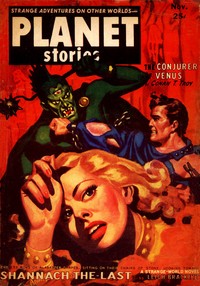
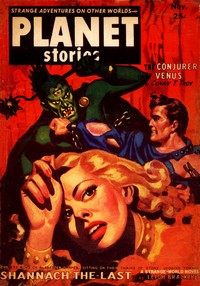
From its opening line, Jack Bradley's 'The Rhizoid Kill' drops the reader into a Mercury swamp where the protagonist Mallard feels 'really afraid'—a rare admission for a hardened space rat. The story, originally published in Planet Stories (November 1952), wastes no time establishing a world of predatory plant slugs, webbed-foot swamp girls, and the coveted rhizoids: gems that 'harnessed every brilliant sun of the Galaxy.' The narrative shuttles between the swamp's immediate dangers and a flashback to Venusport, where Mallard's partnership with the ruthless Bill Olger and the enigmatic Martian D'ulio begins. This dual timeline creates a tension between past bargains and present survival, a structure that keeps the reader guessing at the helmet's true value and the alliances' fragility.
The story's central conflict is not just against the swamp's fauna but within the human trio. Mallard, a former Patrolman turned 'space rat,' is introduced nursing a hangover in the dive bar Green Star, his nerves 'raw from a week-long bout with the Sre.' Olger and D'ulio approach him not as friends but as opportunists who 'know about you.' The Martian D'ulio is described as having a 'red, skeleton-like face' and is immediately distanced by the narrator's admission that 'no Earth man ever would know what a Martian was like.' This cultural opacity becomes a plot device: D'ulio's scientific expertise is both essential and suspect. The partnership is built on mutual need, not trust, and the narrative repeatedly underscores that each member is ready to betray the others for the rhizoids. Mallard's internal monologue reveals his plan to 'be free of Bill Olger and D'ulio' once he secures the helmet, setting up a three-way race for the prize.
Bradley paints the Mercurian swamp as an active antagonist, teeming with lethal flora and fauna. The 'huge plant slug' that glides past Mallard is 'nearly forty feet in length' and moves 'with the speed of an express train.' The environment is claustrophobic: dense fern growth, mud that grips webbed feet, and 'deadly fungus stumps' that release spores capable of killing a man. The swamp girl, a native Mercurian, navigates this terrain with ease, her 'webbed feet gripping the mud firmly,' contrasting with Mallard's clumsy fear. The rhizoids themselves are hidden inside white stumps that must be split open—a detail that ties the treasure directly to the swamp's biology. The setting is not a backdrop but an active force that shapes every decision, from the pace of the treasure hunt to the final confrontation where a fungus fragment becomes a weapon.
The climax hinges on a double betrayal that recontextualizes the entire quest. The swamp girl, who had been Mallard's guide and apparent ally, suddenly reveals her allegiance to the Mercurian warriors. At the command of a helmeted warrior, she 'answered!' and, despite a spear wound, snatches the pouch of rhizoids and hobbles toward her own people. This moment is preceded by Mallard's discovery that the warrior wears 'an exact duplicate' of his own helmet—a detail that suggests the helmet is not a unique artifact but part of a native technology. The helmet's protective function is hinted at when Mallard realizes that in his prone position 'it would not shield him,' but its full capabilities remain unexplored in the excerpts. The story's title, 'The Rhizoid Kill,' takes on ironic weight as the very stones Mallard covets become the cause of his downfall, with the fungus spore cloud delivering 'pain greater than he had ever known.'
Readers should pay close attention to the story's use of sensory details—the 'sweat pouring from him in torrents,' the 'moan of anguish' from the girl, the 'puff of smoke' of spores—as these ground the pulp plot in visceral experience. The incomplete excerpts leave open questions about the helmet's origin and the Mercurians' motives, inviting speculation about how the culture's relationship to the rhizoids might differ from the human treasure hunters' greed. Bradley's prose moves at a breathless pace, but the story rewards a careful reading of its environmental and character cues.
I keep thinking about that swamp girl’s quiet turn in The Rhizoid Kill, how trust just dissolved between breaths. It reminded me of stumbling through the layered stories in This Way to the Egress — Text and Context — where every exit leads somewhere unexpected, and the leaving itself stays with you long after the page settles.
A brief reflection can help important ideas stay with you longer.