About 82 minutes
Vandals of the Void — Inside the Classic
Machines Invention
18,767 recorded words. 19 minutes difference from this book's estimate.
View Gutenberg source #63518
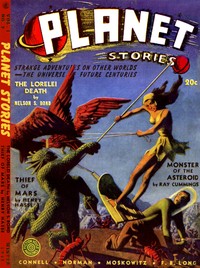
This digital edition of Monster of the Asteroid — Text and Context is described by source-level measurements including 14,341 words, 1 hr 3 min estimated reading time, and 2 detected text sections.
The text analysis averages about 13.7 words per sentence, while the detected sections provide another way to judge how the source is divided.
Project Gutenberg metadata also associates the work with “Science fiction,” connecting these edition facts with the source record’s subject description.
Explore this collection
These alternatives are selected using recorded categories and estimated reading time.
About 82 minutes
Machines Invention
18,767 recorded words. 19 minutes difference from this book's estimate.
View Gutenberg source #63518About 36 minutes
Machines Invention
8,151 recorded words. 27 minutes difference from this book's estimate.
View Gutenberg source #61498About 33 minutes
Machines Invention
7,479 recorded words. 30 minutes difference from this book's estimate.
View Gutenberg source #63891Search stored excerpts and compare books → Choose by your preferences →
Choices use stored catalog measurements. Estimates vary with reading speed. A shared category is a catalog label, not a claim that two books have the same argument or literary quality.
Search reads excerpt text stored with this catalog and links to its associated Gutenberg record. The connection is stored in the site database; this tool does not recheck that every excerpt is word-for-word identical to that external record. Excerpt search does not cover every chapter and does not verify historical publication dates.
Catalog snapshot checked: 2026-09-26. Coverage: 90 public books, 90 available source excerpts.
Calculated from edition completeness, EPUB availability, text structure and catalogue metadata. Not a user rating.
Total of 100 points, scaled to a 2.5-5.0 range. Editions with an empty description or a missing EPUB file are not scored.
Public-domain source text
The source text is kept in the dedicated reader, separate from this catalogue record and its commentary.
The story begins not on an asteroid but in a public park in 1965, where the narrator and Dora Franklin listen to outdoor music under colored tubelights. A furtive man in a black cloak and his headless-looking companion approach them. The catalog subject 'Inventors — Fiction' finds no support in the excerpts; no inventor appears. Instead, the narrative quickly moves to an asteroid where a rooted, telepathic alien—the 'Monster'—enslaves humans through Physicals, its detached body parts.
The opening paragraphs establish a deliberately romantic mood: 'My arm went around Dora, with her head against my shoulder as we listened to the soft exotic music.' The setting—a bench under overhanging branches, crescent rows of listeners, colored tubelights—evokes a familiar, safe world. This normalcy is shattered by the arrival of two figures: a tall man in a dull-black cloak and a short, headless-looking shape under an overcoat. The narrator's 'vague shudder' and the companion's immobility hint at the uncanny. The contrast between the lovers' intimacy and the intruders' strangeness sets up the abduction that follows.
The central alien is described in elaborate biological detail: a 'fifty foot circle' of 'quivering, palpitating, luminous mass' suspended in the air, connected to the ground by 'violet curtain or radiance.' It has 'multiple brain-lobes,' a giant eye on a flexible stem, and organs that pump 'strange current' through its tissue. The Physicals—small, policeman-like creatures—are revealed as 'parts of the monster,' linked by 'evanescent threadlike streams' that transmit orders. This conception of a stationary, telepathic alien with remote-controlled bodies is the story's core speculative idea, more prominent than any human invention.
The excerpts show the narrator and Dora as captives on the asteroid, shoved along a rocky path past 'staring captive humans' to the monster's lair. The catalog subject 'Human-alien encounters' fits, but the nature of the encounter is one-sided: the monster appraises them with its central eye, and the narrator feels 'a weird feeling... as though I was gazing at a living thing of vast immensity.' The excerpts end before any resolution, so the story's outcome—whether the humans escape, resist, or are absorbed—remains unknown. The catalog also lists 'Asteroids — Fiction,' which the setting confirms, though the asteroid itself is merely a barren stage for the monster.
Readers should note that the excerpts cover only the opening abduction and the initial confrontation with the monster. The story's full arc, including any role for the hinted 'inventor' or the fate of the captives, is not represented here. The narrative voice is first-person, limited to the narrator's perceptions, and the prose mixes pulp romanticism with detailed speculative biology. The monster's description—part electronic, part organic—is the most distinctive element.
There’s something haunting about how Cummings imagined those rooted alien masters, their control reaching out like vines across the asteroid’s dark. That ache of human will fighting something vast and indifferent stayed with me long after. I found a similar lingering weight in Total Recall — Inside the Classic, that same uneasy sense of memory and freedom getting tangled together.
Answer a few questions and save a private reflection on this device.